What you need from your clinic
- Do I have AMD?
- If yes, what stage (early, intermediate, advanced)?
- What findings support that staging?
AREDS2 is one of the most misunderstood “eye supplement” topics. The correct version is not hype: it’s a stage-specific risk-reduction tool for certain people with AMD.
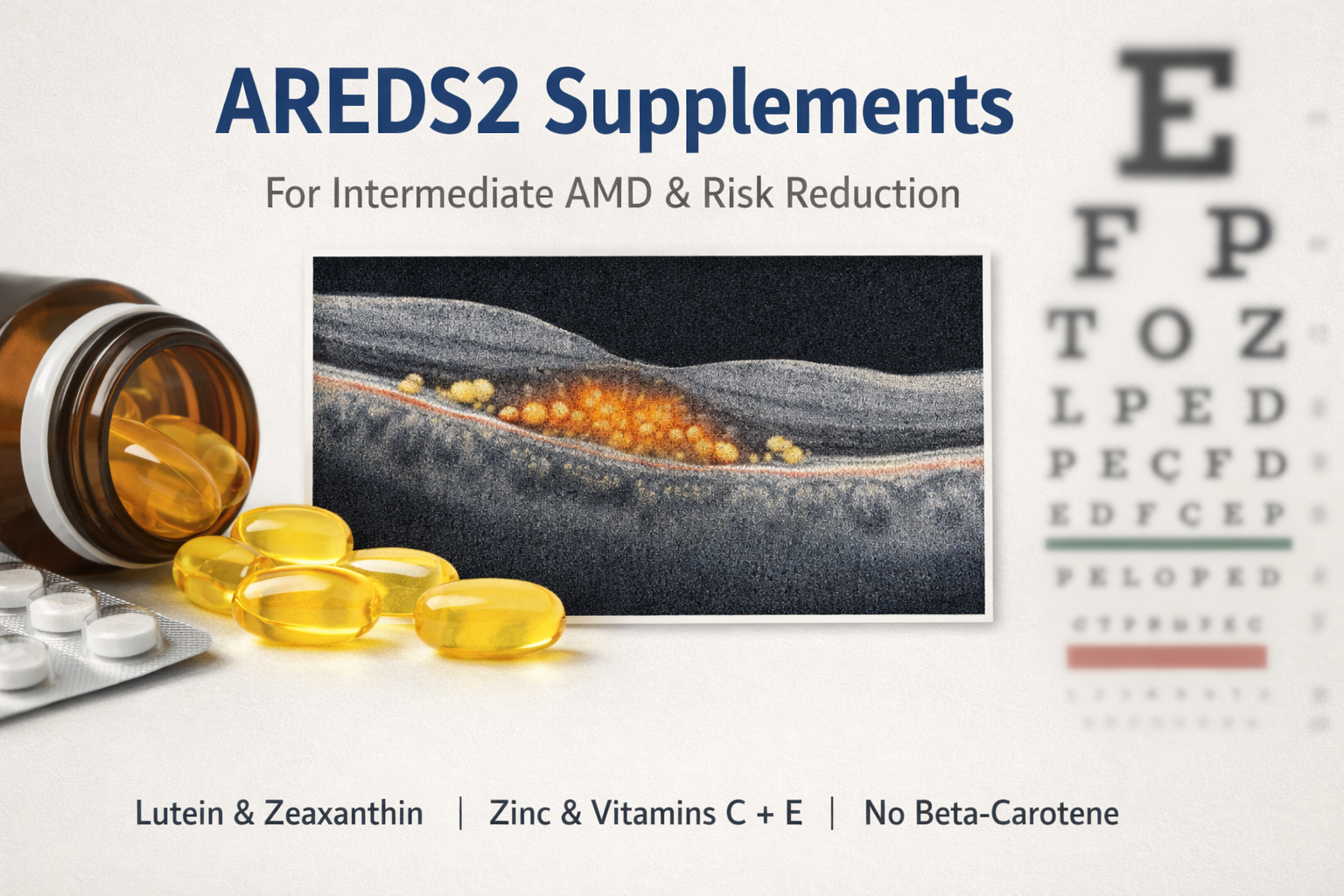
AREDS2 is not for “eye health.” It’s for defined AMD risk reduction.
AREDS2 is discussed like a universal eye vitamin. That framing causes two errors: people who might benefit don’t take it, and people outside the evidence group take it expecting vision improvement. The evidence-based framing is narrower and more useful: an AREDS2-style formula can reduce progression risk to advanced AMD in certain risk categories.
Because the goal is preventing a specific kind of progression.
AMD is not one uniform condition. Early findings can be mild and stable. Intermediate stages can carry higher risk of progression. Advanced AMD is the stage where central vision can be significantly threatened. AREDS2 discussions are typically anchored to preventing that progression in people who are already at meaningful risk.
A dilated exam plus retinal imaging (photos and sometimes OCT). Your clinician interprets features like drusen, pigment changes, and other signs that correlate with risk.
Without staging, supplements become a superstition. With staging, it becomes a risk-management decision that can be discussed clearly.
The real-world “yes” conversation.
In practice, clinics recommend an AREDS2-style approach when your macular findings place you in a higher-risk group for progression. The conversation is usually: “You have findings that put you at risk; here’s what we can do to reduce that risk while we monitor.”
Early AMD can be a counseling moment: risk factors, monitoring, and sometimes targeted supplement discussion depending on the specifics. The key is that the plan is individualized, not automatic.
Risk reduction, not instant clarity.
People often judge supplements by whether they “feel” different. That’s the wrong metric here. The meaningful outcome is whether you reduce the chance of progressing to advanced AMD over time. That’s why follow-up and staging are part of the story: the supplement is one component of an overall long-term strategy.
Smoking avoidance/cessation, cardiovascular risk management, and consistent follow-up are often the bigger levers. Supplements are supportive, not magic.
Where people waste money or get false reassurance.
If you don’t know you have AMD (and what stage), the decision is unanchored.
Supplements don’t replace imaging and exams. They work best when paired with a follow-up interval and clear triggers.
People mix and match ingredients. If your clinician recommends AREDS2, ask what they mean by that and why that formula fits your risk.
A script that produces a real answer.
“Can I get copies of my retinal photos/OCT reports?” Trend data helps if you switch clinics or seek a second opinion.
For second opinion strategy and records, see Care Guide.
Common questions, answered clearly.
Usually no. The evidence-based approach targets people in a defined risk group. The first step is confirming AMD and staging.
That is not the realistic framing. The goal is reducing progression risk in a defined group, paired with monitoring.
Ask for a retinal evaluation and clarity on whether you have AMD changes. If you’re not sure what was checked, ask whether retinal photos or OCT are appropriate in your case.